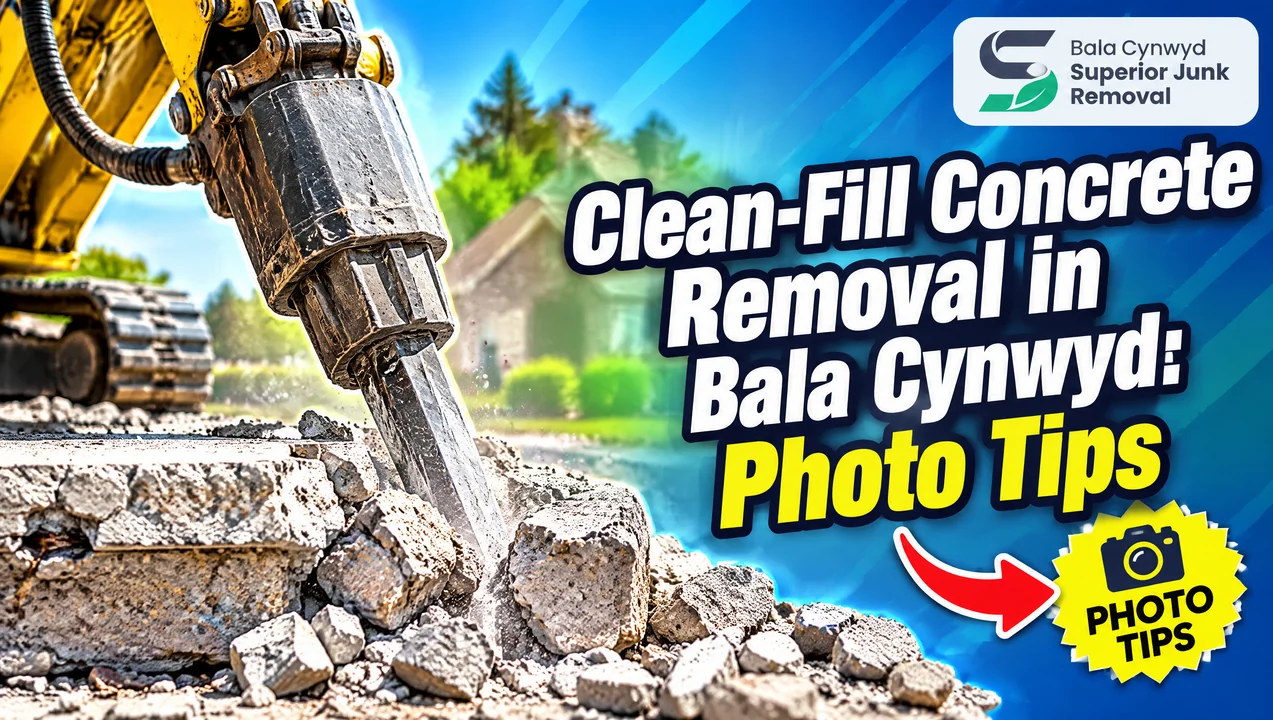
A caller from the Main Line recently asked us about getting concrete hauled away. They called it “clean fill” and weren’t sure the one photo they’d emailed was enough. Clean-fill concrete means concrete with nothing else mixed in, and the quickest way to a price for concrete removal is to text photos or book a free pickup consultation.
What to know
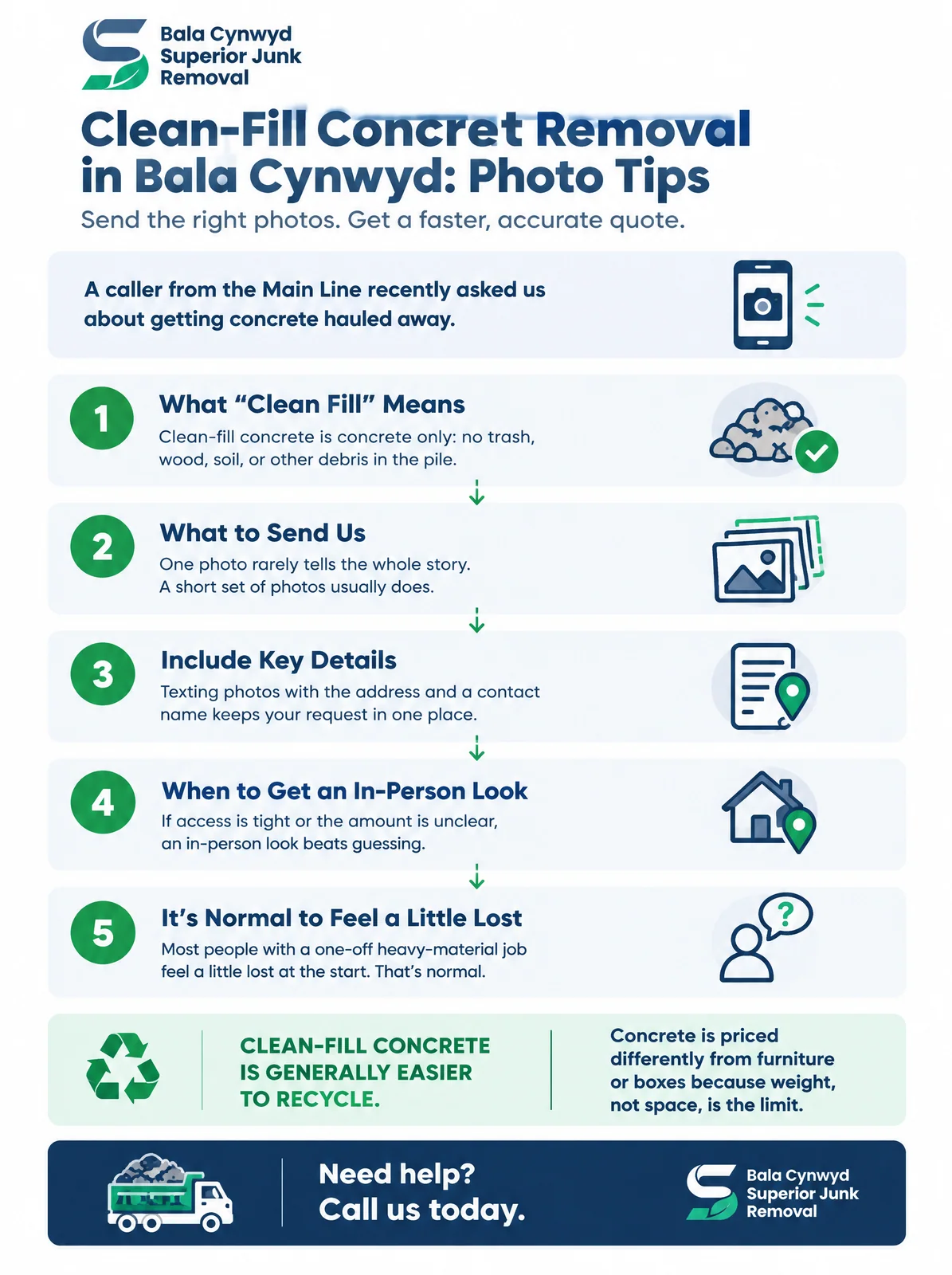
- “Clean fill” generally means concrete only: no trash, wood, soil, or other debris in the pile.
- Concrete is priced differently from furniture or boxes because weight, not space, is the limit.
- One photo rarely tells the whole story. A short set of photos usually does.
- Texting photos with the address and a contact name keeps your request in one place.
- If access is tight or the amount is unclear, an in-person look beats guessing.
Most people with a one-off heavy-material job feel a little lost at the start. That’s normal. This guide walks through what the term means and what to send us, so your first message is the useful one. If you’d rather talk it through, we handle junk removal in Bala Cynwyd and the surrounding towns every day.
What “Clean Fill” Concrete Actually Means
Clean-fill concrete is broken or solid concrete that has nothing else mixed into it: no trash, lumber, soil, or other building material. Because it’s a single material, it is generally simpler to handle and more likely to be recycled than a mixed pile.
The exact definitions can vary depending on the facility that takes the load, so we confirm the details when we see your photos.
What Counts as Clean Concrete
Think of a driveway that’s been cut out and broken into pieces. Or a patio, a set of old steps, a stretch of walkway slab. If the pile is gray, hard, and nothing else is tangled in it, that’s the picture most people mean by clean fill.
What Turns a Concrete Pile Into Mixed Debris
A pile can start clean and end up mixed without anyone noticing. A few shovelfuls of dirt scooped up with the pieces, a leftover board from the form, and suddenly it’s a different kind of load. Mixed loads may be sorted, handled, and quoted differently, which is exactly why we ask what’s in the pile.
| What’s in the pile | Why it matters |
|---|---|
| Rebar or wire mesh | Metal sticking out of concrete changes how it’s loaded and sorted |
| Dirt or gravel | Soil clinging to the pieces can change what the load is considered |
| Wood forms or scrap lumber | Wood has to be separated from the concrete |
| Asphalt or brick | Different materials, handled separately from plain concrete |
| Trash bags or household junk | Turns a concrete load into a mixed one |
If your project produced a mix of materials, our construction debris removal service is built for that kind of job.
Why Concrete Isn’t Priced Like a Couch or a Pile of Boxes
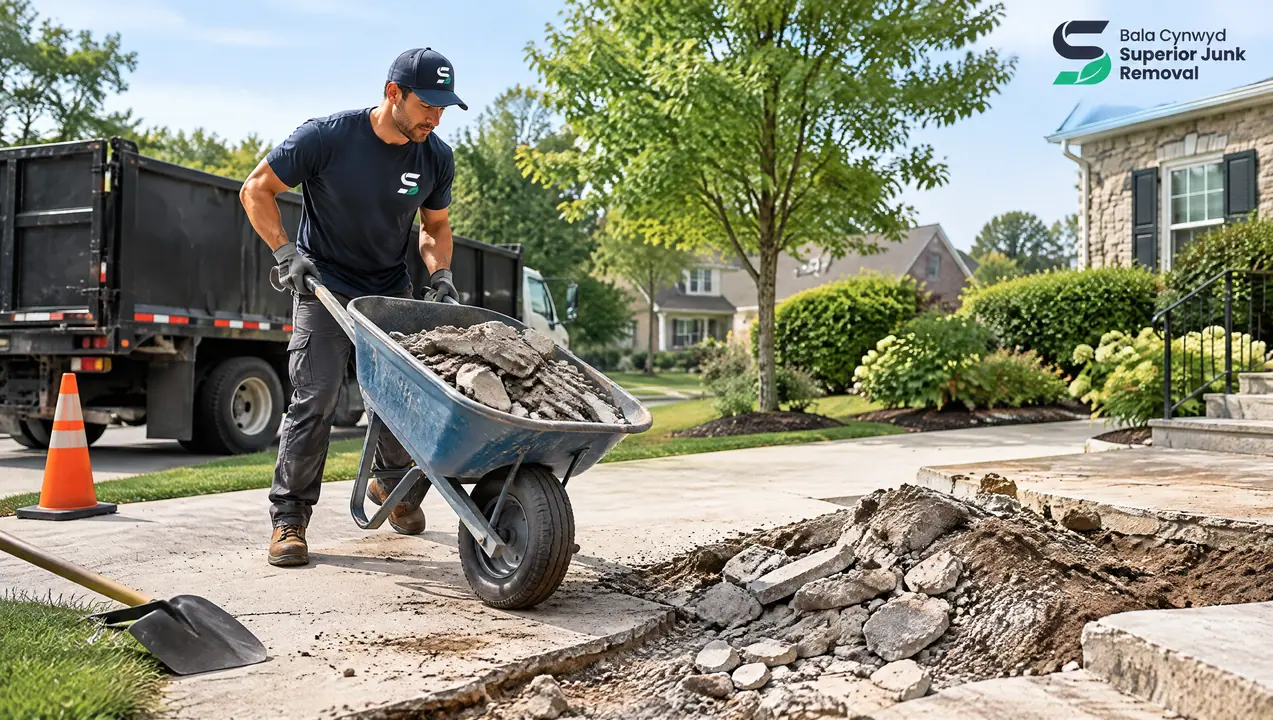
Concrete is a weight problem. A pile that looks small can be punishingly heavy, and that’s why we can’t size it up the way we would a bulky but light pile of furniture.
Weight vs. Truck Space
A truck can reach its weight limit long before it runs out of room. Picture a few broken patio slabs: they barely cover the truck bed, yet they can account for a big share of what the truck can legally carry. Anyone who has tried to lift a single broken step knows how fast that adds up.
Other Things That Change the Estimate
Weight is the big one, but it’s not the only one. When you reach out, these are the details that help us most:
- How big the pieces are, and whether the concrete is already broken up or still a solid slab
- How far it sits from where a truck can park
- Stairs, gates, or narrow side yards between the pile and the street
- Anything else mixed in, from rebar to leftover lumber
- Whether it’s a single pile or spread across the property
We’d rather ask these questions up front than surprise you with them on pickup day. Our approach is transparent pricing, and that starts with a clear picture of the job.
How to Get a Concrete Removal Estimate: Photos or a Free Pickup Consultation
There are two ways to start, and both are free: send photos, or schedule a pickup consultation where we look at the concrete in person. The caller I mentioned had done the first step the day before, then wondered if that was all. It’s a fair question.
What to Photograph
One photo shows that concrete exists. It doesn’t show how much, how thick, or how we’d get to it. A few extra minutes with your phone makes the estimate far more accurate.
Photos to take before you text us
When a Free Pickup Consultation Makes More Sense Than Photos
Photos are quick. A consultation takes more of your time, and it’s worth it when the job is hard to judge from a screen.
| Situation | Better starting point |
|---|---|
| A modest pile of broken pieces, easy access | Photos |
| A large slab still in the ground | Consultation |
| Concrete mixed with other debris | Consultation |
| Tight access, stairs, or a long carry | Consultation |
| You’re not sure how much there is | Either; photos first, consultation if we still have questions |
If the slab is still in place and has to be broken up first, that’s a conversation about our light demolition services as well as hauling.
Have concrete to get rid of? Text your photos, the job address, and a contact name to 6107952362 and we’ll reply with next steps.
Why Texting Photos Can Be Easier Than Emailing Them
Our caller’s email went to a general support inbox, not to the team that would actually quote the job. That happens more than you’d think, especially when you’re hunting for an address on a website. Texting skips the problem. The photos, the address, and your name all arrive in one thread, and we can answer you in that same thread.
What Happens After You Send Photos
The flow is simple. You send photos and the address. We look them over and reply by text, often with a question or two about access or what else is in the pile. From there we settle on a time. You don’t need to be on a call, and you don’t need to move a single piece yourself.
Where Clean Concrete Goes After It Leaves Your Property
Concrete that’s free of contaminants is often a good candidate for recycling or reuse instead of landfill. We care about keeping reusable material out of the waste stream, and a clean, separated pile makes that far easier. Ask us how your particular load would be handled.
Before the Pickup: Small Things That Keep the Job Simple
You don’t have to do much. A little prep goes a long way, though:
- Keep the concrete apart from household trash and yard waste
- Pull out loose boards, buckets, and bags that don’t belong to the pile
- Clear a path wide enough to move heavy pieces
- Make sure a truck can get reasonably close
Can a truck back up to the pile, or is there a fence in the way? Tell us either way. Knowing is better than finding out on the day.
Ready to Find Out What Your Concrete Pickup Would Involve?
Text your photos and the job address to Bala Cynwyd Superior Junk Removal at 6107952362, or contact us for a free quote and ask for a pickup consultation. We’re licensed and insured, with more than 20 years of local experience and straightforward pricing. Not sure we cover your street? Check the areas we serve.
Send your concrete photos and address by text, and we’ll tell you what the job takes and how to schedule it.
Common Questions About Concrete Pickup
Can you haul away concrete, or only regular junk?
We look at concrete jobs case by case. Send photos or book a free consultation, and we’ll confirm what we can take and how.
What does “clean fill” mean?
It means concrete with nothing else mixed in, so no trash, lumber, or soil. Facilities can have their own definitions, so we confirm the details for your load.
Is one photo enough to get a price?
Usually not. A wide shot, a close-up of the thickness, and a picture of the access route give us what we need. The checklist above covers it.
Should I break the concrete up before pickup?
Don’t start swinging a sledgehammer until you’ve talked to us. Whether it’s better to break it up first depends on the size of the slab and how we’d load it, so ask before you do.
Is concrete charged by weight or by the truckload?
It depends on the job. That’s why photos or a consultation come first, and we explain the price before anything is scheduled.
Is it better to email photos or text them?
Text. It reaches us directly, keeps your address and contact info with the photos, and avoids the wrong-inbox problem our caller ran into.